

It doesn’t matter if Jay Hutchinson is walking the streets of Dunedin or New York – his head will be down looking at the footpath
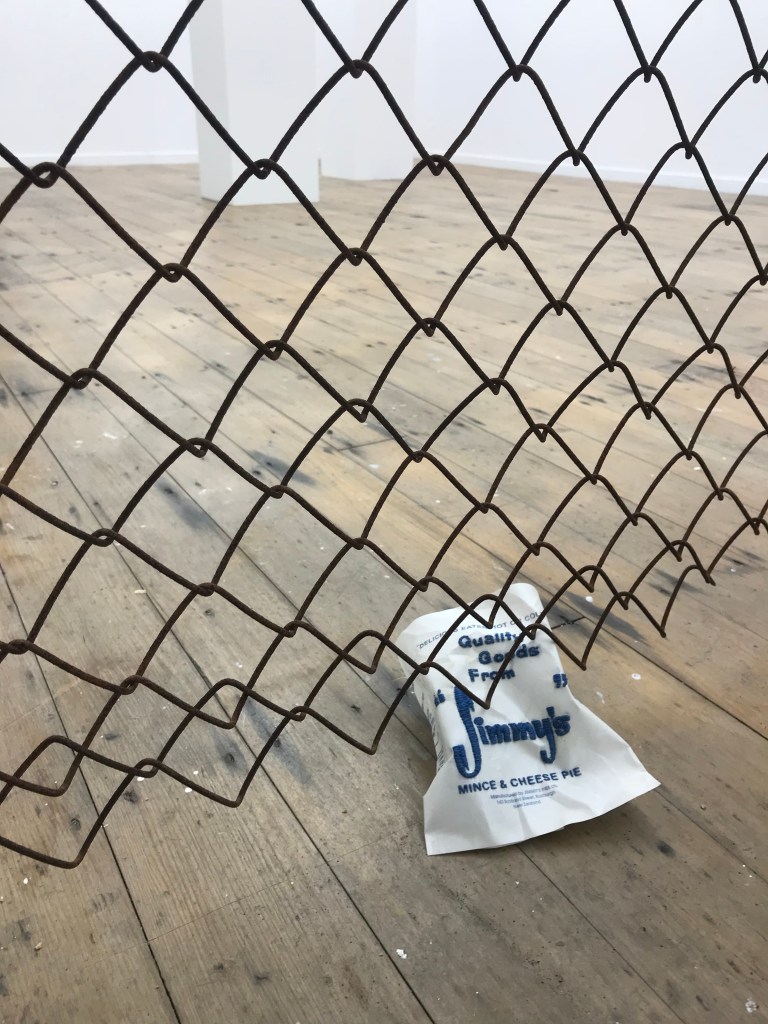
“I’m constantly walking around looking at the ground, the Dunedin artist says. While many artists are inspired by the sights and sounds around them, Jay is only interested in the footpath, gutter or road verge – anywhere where society’s detritus collects. Yes, Jay is after our rubbish – the chip packets, drink cans, lolly wrappers, cigarette packets and fast food wrappers that float around city streets and country roads. “We got off the plane in New York and my wife was pointing out the buildings and I was really excited I’d found this bright, colourful piece of American rubbish you wouldn’t get in New Zealand. “She was like ‘typical, I’m looking at the buildings and you’re looking at your feet.” And it is not just the item itself he has sought to re-create using his chosen medium – embroidery – but also the area it was found in. Like a hand-embroidered, digitally printed silk jimmy’s mince and cheese pie wrapper, inspired by a wrapper of the Dunedin “icon” he found under a fence.
The Dowse Art Museum in Lower Hutt, a gallery known for pushing boundaries in what it displays and collects, purchased the work and the section of fence where it was found. That work, alongside fellow Dunedin artist Victoria McIntosh’s My Handbag, My Choice’ (2019), are being heroed in the gallery’s latest exhibition Unhinged: Opening the Door to the Dowse Collection, an effort to showcase the variation and quirkiness of the more than 1000 pieces on show. “Prepare to be enchanted, baffled, and surprised,” the Dowse’s senior curator Chelsea Nichols says. For Jay, being showcased in the exhibition is pretty special, given he used to work for the Dowse as an exhibition technician. These days he lives in Dunedin and does a similar job for the Dunedin Public Art Gallery.
While admitting embroidery is not a common medium for a bloke, he says it comes with some serious advantages. “It’s not like being in a cold, damp studio; it’s sitting in front of a fire with an embroidery hoop – a little bit different from some painting studios I’ve visited in Dunedin where you have 20 jackets on in the middle of winter.” He admits a lot of his friends made fun of him in the beginning because he was sitting around sewing. “But now they generally all have my works on their walls or bother me when they have major birthdays.”
Exhibitions of textiles are usually dominated by women, with Hutchinson often finding himself being the “token” male. He was the only male studying textiles in his year – or the one above and the one below him. “Generally I don’t like to think of gendered things, but I was doing something different from what the women were doing, probably because of my age at that time.” It never really worried him, as he started out doing a hairdressing apprenticeship. He had dropped out of school and with his parents urging him to get a trade, he, being a sensible teenage boy, followed the girls into hairdressing. He then decided to give art school a go in the late 1990s. “I’ve always been working on something. I drew constantly as a kid and I kind of relate my work to drawing” Jay studied for a jewellery and textile diploma at the Dunedin School of Art, although what he really wanted to do was graffiti-style paintings, as he was still painting on the streets at the time. “I ended up really liking textiles. I found my work was much stronger in textiles, so I slowly moved away from jewellery.

“That relationship with the street influenced my new work” So he went on to do a Bachelor of Fine Arts majoring in textiles, with screen printing and dyeing his focus, and making big, street-art-inspired pieces – such as in his first solo show in 2006, From Textile to Concrete, in which he took graft from around Dunedin and re-created it in textiles.was hand-stitching and staining the fabrics to re-create the surfaces.” After his undergraduate degree, he had a year off “back washing dishes” and thought he “may as well” go back and do his master’s degree and take his art a bit more seriously. “It taught me a really strong work ethic and good studio practice” This was important for Jay, as his work is mostly very portable, although when he first started he made large, hand-embroidered graffiti works. “You can take it anywhere with you. I move into various rooms around the house like a cat following the sun” He spends two to three hours a day on his work. His large record collection gets regular use as background to his work, and he is often found with a coffee at his elbow. Then he has a studio day where he puts works in frames.
The works begin with Jay printing his photographs of the rubbish item onto fabric, and then he embroiders chosen details into it before he frames it. “You’re trying to get them to sit the same way theyd appear on the street.” While he makes smaller works these days, the principles are the same. It is slow, methodical work, but he has become much faster over the years. Most of his works take between 10 and 100 hours to complete. His inspiration comes from the streets he walks down. While in the early days he was on the lookout for graffiti, these days it is what gets left behind – whether in streets overseas, Nelson or in Dunedin- that inspires him. “I did one project looking at the rubbish on the streets, then the concrete underneath it. “The idea was hand-embroidered rubbish on top of hand-embroidered concrete, then slowly it just became hand-embroidered rubbish. It kind of relates to the spaces I traverse.”
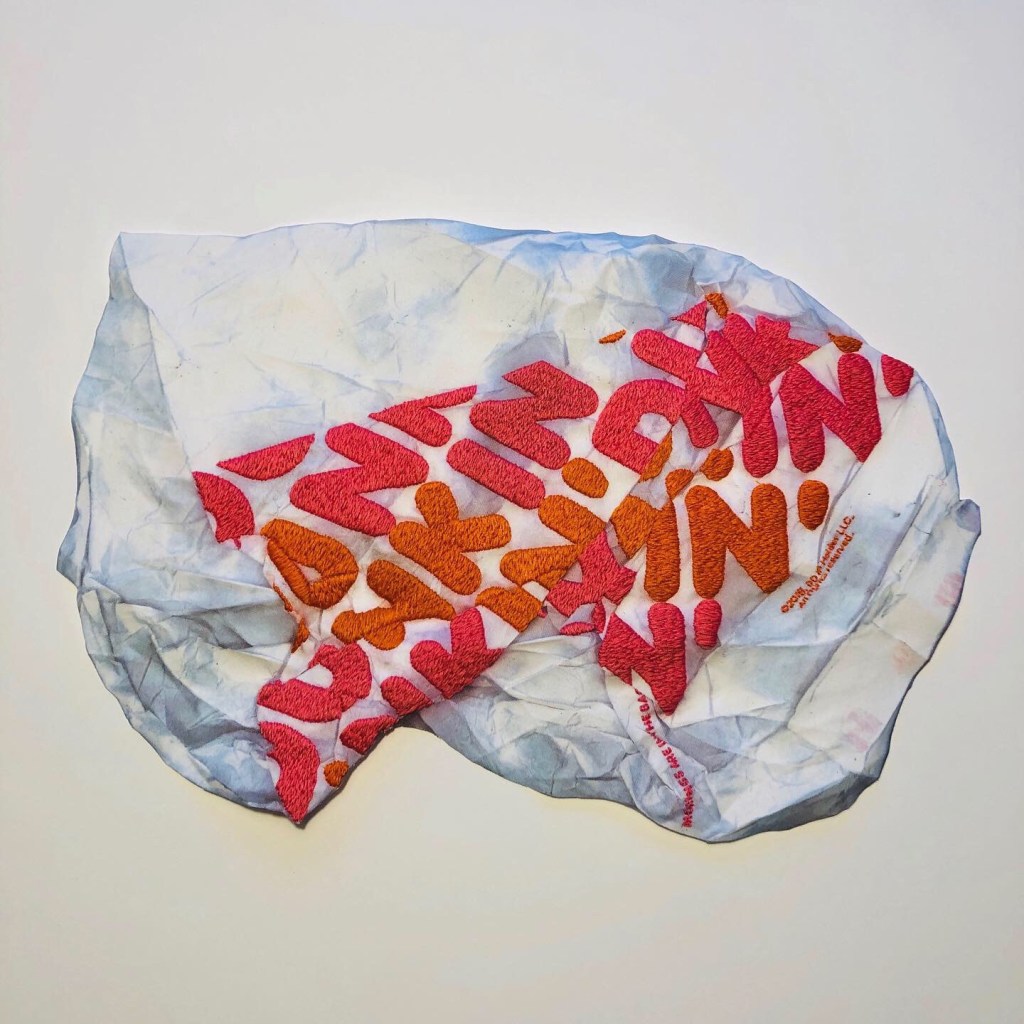
Jay has found that rubbish is the same wherever he goes. “On a trip to New York, McDonald’s and Coca-Cola dominate the litter. Didn’t see any KFC litter in the States, though. You never come across health food; people don’t litter health food packaging” On that trip alone he collected 50 pieces of litter, but he had to cull it to 15 pieces to bring it home. “Going through customs you’re constantly wondering what they’re going to say about what’s in your bag. I’ve got bags of litter at home. Tidy Kiwi.”
He always photographs the litter before he picks it up and showcases those pictures alongside his embroidery. “So it has that context. I’m not just trying to show the product, but trying to show the dirty, screwed-up torn packaging, flashes of colour in the gutter. I’ve started to be interested in everything around them as well. It’s the compositions the streets make Canadian author Naomi Klein’s No Logo book, about how products and brands exist in the shop with what packaging surrounds them, and then continue to advertise and promote again – although for more negative reasons – in bins, gutters and streets, resonates with him. “It relates to the environment and landfills, landfills are just crazy.”
He grew up in a military family that moved around a lot, but his mother was always very environmentally conscious, composting and recycling long before it was mainstream. “In a lot of ways it rubbed off on us.” As a child of the 1980s he remembers the days before mass production dominated the country’s purchasing. “Textile work is about time. It takes time to make it, filling in one stitch at a time while people like things fast these days – fast food, fast fashion, everyone is in a hurry, whereas with embroidery or hand-stitching it slows everything down.” One of his recent projects is a play on Otago-based literary magazine Landfall. Hutchinson’s magazine is called Landfill, and is a mix of essays by local writers and his own textile and photographic works. “My phone is full of rubbish photos. You’ve really got to search to find photos of my cat, or my wife, who doesn’t like photos. It’s seriously ridiculous.”

 a gallery presents