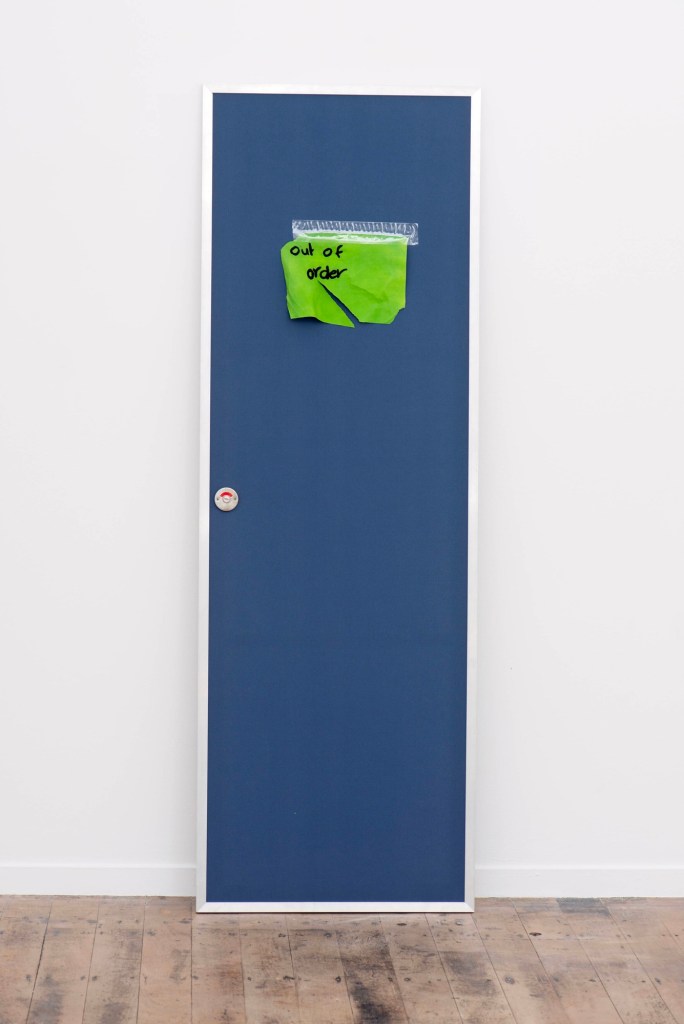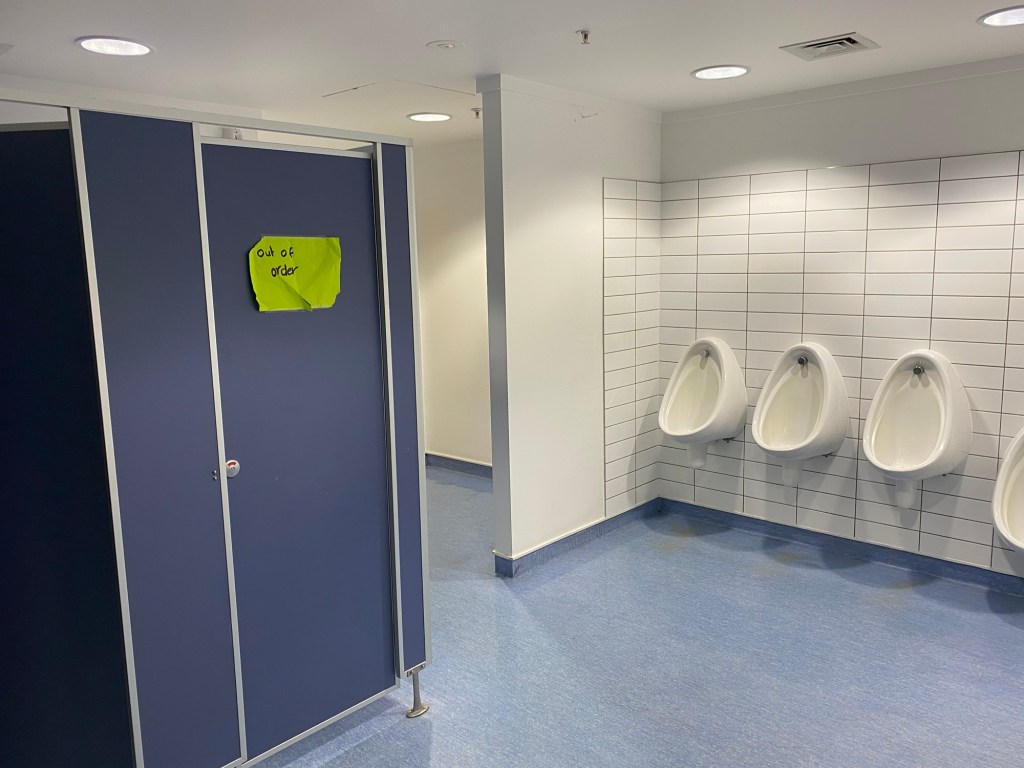
There was a broken toilet cubicle in the men bathroom at the Dunedin Public Art Gallery. Something you usually wouldn’t notice. But as I work at the gallery I noticed it was closed for over six months. I watched for months as the hand written sign on the door slowly eroded over time, small rips became tears. The temporary cello tape pulling away from the surface. The text slowly fragmented as parts of the words pulled away from one another.
I decided it would be interesting to hand stitch a copy of sign in its decayed form and swap it out. Fantasising of a formal event occurring in the space, a string quartet in the corner in front of the urinals, well dressed waiters passing out glasses of champagne and plates of oeuvres. Alas upon finishing the work the cubicle had been repaired, no longer in need of a sign. So I made a textile copy of the door. Stretching similar coloured cotton drill around a frame, aluminium edging and a lock sourced from a demolition yard.
The work was included included in the exhibition/fundraiser, ‘Support your local’ that ran for one week at the Blue Oyster Art Project Space 2/4/26
The exhibition included works donated by Nick Austin, Jessica Covell, Scott Eady, Heramaahina Eketone, Peter Hawkesby, Priscilla Rose Howe, Reece King, Saskia Leek, Jess Nicholson, Aroha Novak, and Kate Stevens West.
All works were sold via silent auction with the final sale price being split between the Artist and Blue Oyster.
Meet me in the bathroom
2025
1800mm x 600mm
Hand-embroidery on cotton drill, clear tape, aluminium framing, steel lock
Photo of work in the gallery by Justin Spiers