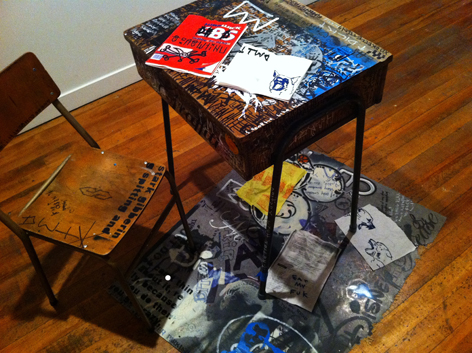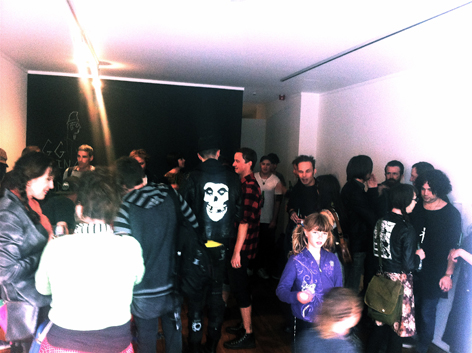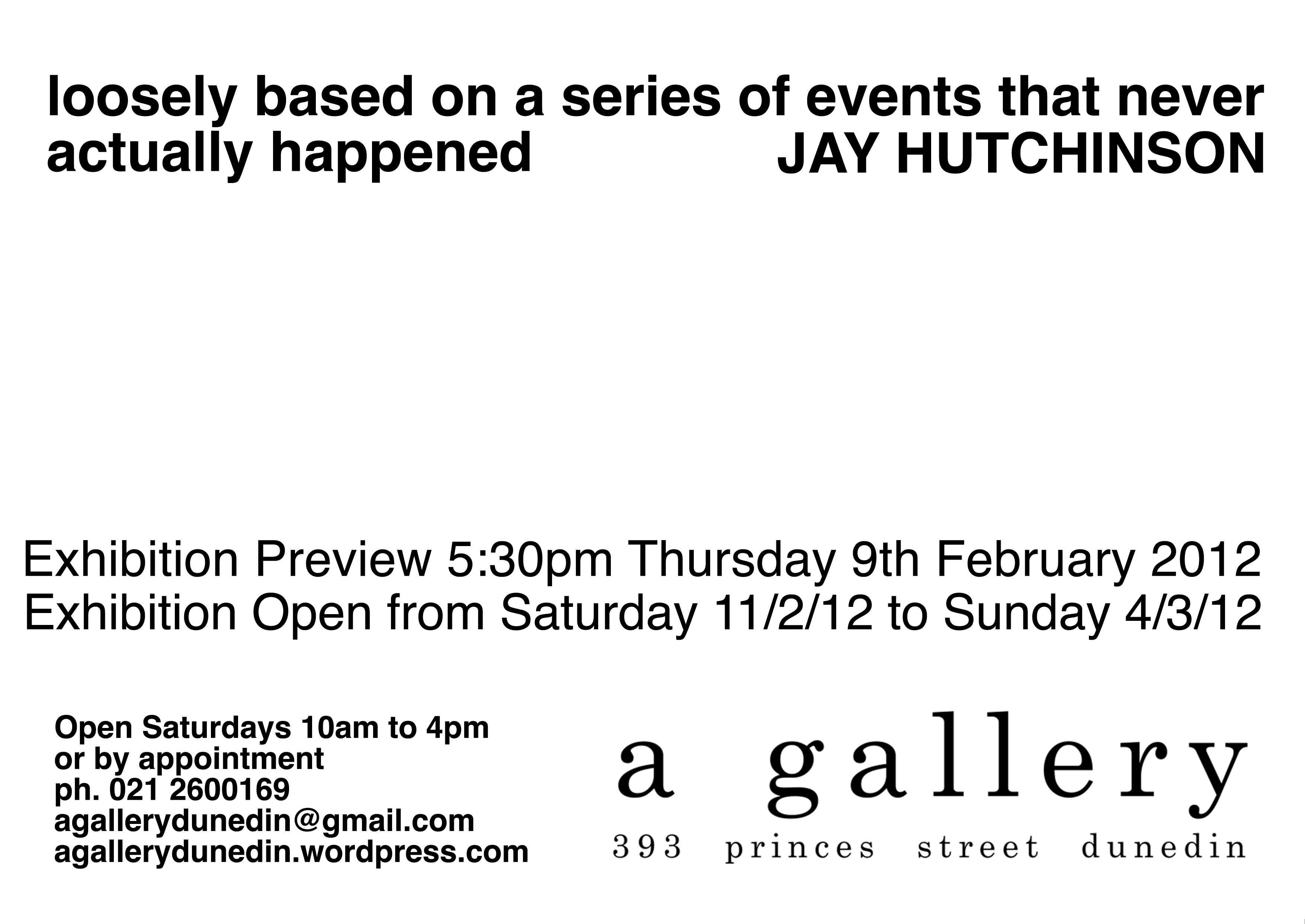
Jay Hutchinson is deeply interested in concepts surrounding memory and historical fabrication. His father is a photographer and Hutchinson’s childhood is fully documented. How many events of our childhoods (and beyond) do we actually remember solely from our own experience? loosely based on a series of events that never actually happened presents memories as after-images, filled in with fragments of stories and photographs, and with other people’s similar experiences. The school desk here is covered in layers of doodles and graffiti, built up by friends and visitors over a 3-month period before the exhibition opened. The wall-size chalkboard is covered in messages and drawings, most done at the exhibition opening, with some adding to it since then. The chalkboard is not listed as part of the work but is a crucial element in creating the school-room setting, a particularly evocative scene in that some of our most formative experiences happen during school years.
With one desk and one chair, both covered in ink doodles and sprayed stencils, the scene is one of ‘time out’ or detention. It felt a bit like a 3D photograph, as I moved around the familiar objects and freeze-frames of nostalgia freely flashed behind my eyes. They are objects snatched out of the past and imbued with the present. Some of the imagery is quite dark: “knife!!”, snarling dogs, a baby’s face scribbled out of a family photograph. However, it’s not off-putting; the imagery doesn’t scare us from imagining answers to questions like, “what happened here?” and “who wrote that?” Hutchinson has created a situation in which participants can choose to anonymously or openly share secrets, and he takes them all and creates layers of what becomes collective memory.
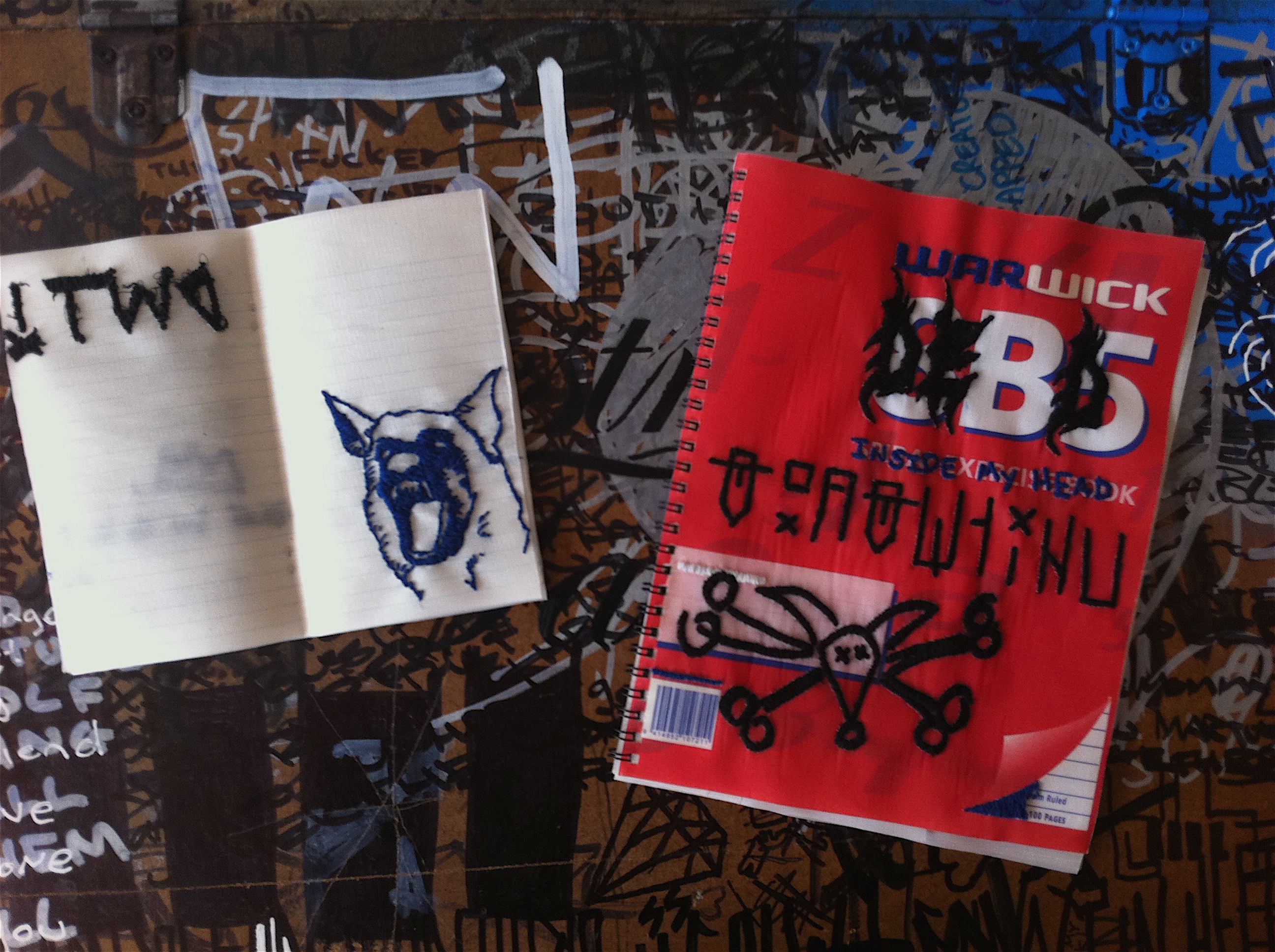
I immediately disagreed with what the title of the exhibition was trying to tell me. As a student in elementary school, I had sat at desks just like this one; I recognised the Superman symbol and the Slayer lettering from fourth form; I remembered lunchtime missions in seventh form to McDonald’s for $1 cheeseburgers: these events had actually happened. But then I had to agree – these doodles and strewn bits of ‘paper’ were from my memory, except they weren’t from my memory. And I looked around thinking these signs meant something to me, that they were part of my history, but they weren’t. They are familiar but utterly foreign. I have never seen a cheeseburger wrapper made from screen-printed silk, and I never did any of my doodling with thread.
Hutchinson’s work simultaneously is and isn’t, and so echoes some of the work by conceptual artists like Joseph Kosuth or Robert Barry. Kosuth famously presented a photograph of a chair, an ‘actual’ chair, and a definition of a chair side-by-side. An objective chair may differ markedly from a subjective chair. The representation of a chair is not really a chair. Hutchinson’s discarded exercise books and ripped-out pages are not made of paper, but you wouldn’t know it unless you picked them up. Then, does it feel the same to you as it feels to me? This exhibition taps into what is often the inadequacy of language to describe subjective, even if similar or universal, experience. At the same time as we feel comfortable around these objects, they remind us through their material that they are not ours.
Materiality and tactility: this work is made. The time put into these pieces, the detail and the technique (including the colour choices), are remarkable. Yet there is a refreshing and exciting yielding of control – in fact, it’s grin-inducing. Hutchinson encourages people to touch the work and play with its positioning. I got the impression he would probably just smile if I spontaneously frisbeed one of the exercise books across the room. Then again, there’s no way I’d try it. It’s surprising how with even the artist’s blessing I was still extremely wary of ‘doing art wrong.’ I still can’t believe I let ‘professionalism’ get the better of me, though. I want to go back and write on the chalkboard. I want to go back and see if there’s anything in the desk. I want to go back and turn the rubbish bin upside down.
The sparseness of the room, the spacing between the two works and the small number of objects leave room for the viewer to move both physically and mentally. Each bit of ‘paper’ is totally different as well, so each evokes a different response or triggers a different kind of memory. The time that went into making the works (Hutchinson has left the backs of his pages bare so we can view the loose threads) is matched by the time the viewer spends either experiencing or thinking about them. The textile element has no association of kitsch handicrafts or novelty. Hutchinson has created thoroughly contemporary and thought-provoking work. These pieces of memory are unequivocally present.