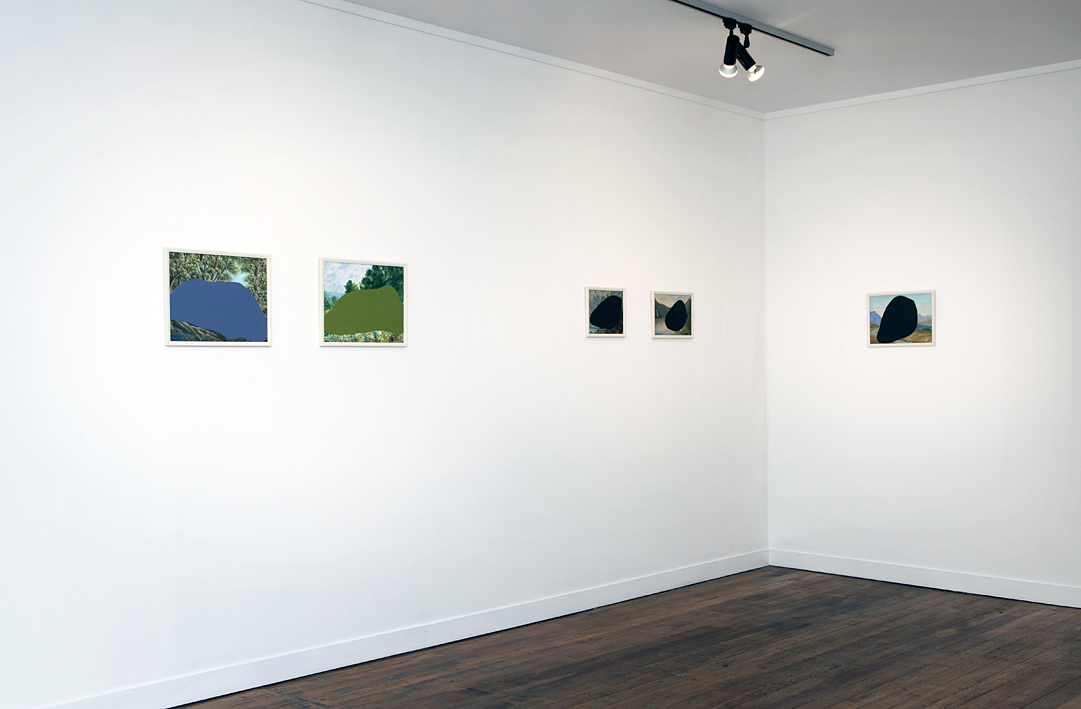
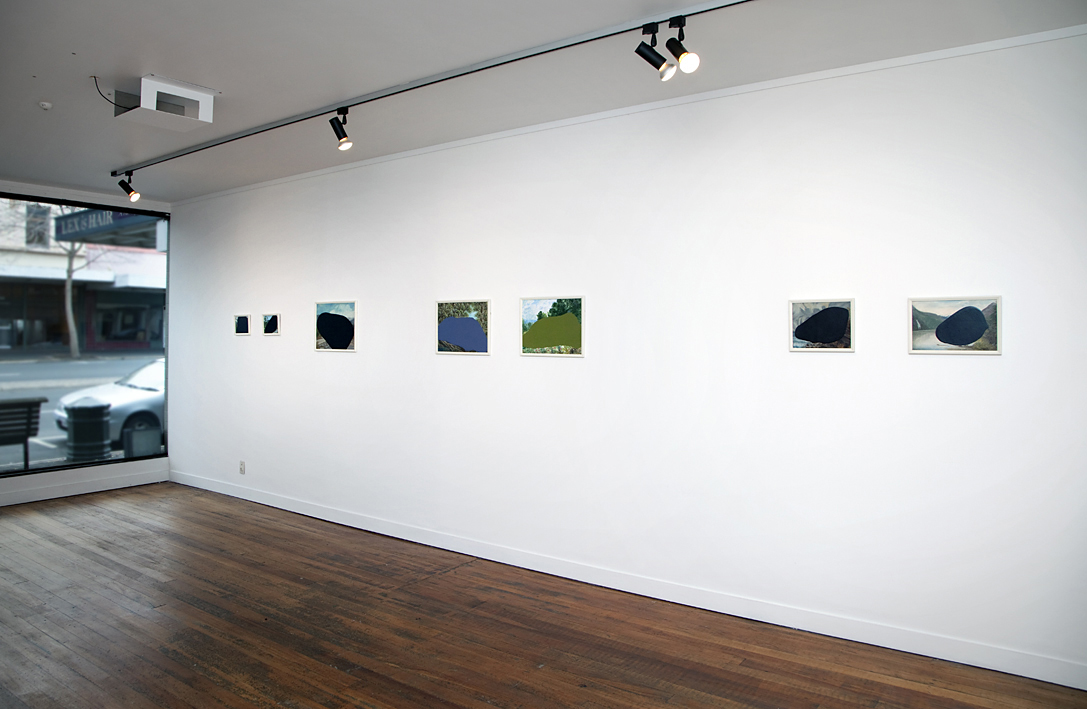
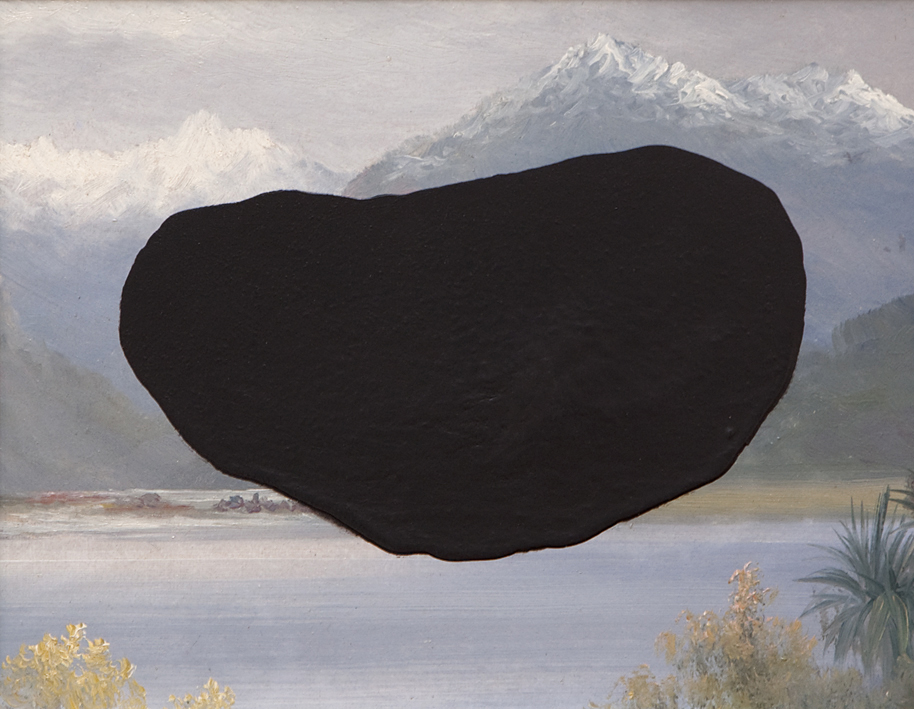
An exhibition of seemingly conventional, uniform landscape paintings is an unexpected site at A Gallery. However, the ideas behind the work of Alexandra Kennedy easily explain the place of New Voids here. Kennedy spent nine months hunting through secondhand shops and garage sales for old paintings. One is a still life – the only hint is in the title, untitled (flower painting) – and the rest are landscapes. She has painted black ‘voids’ onto the surface of each, except for untitled (river and bush) and untitled (river and bridge), whose voids are blue and green respectively.
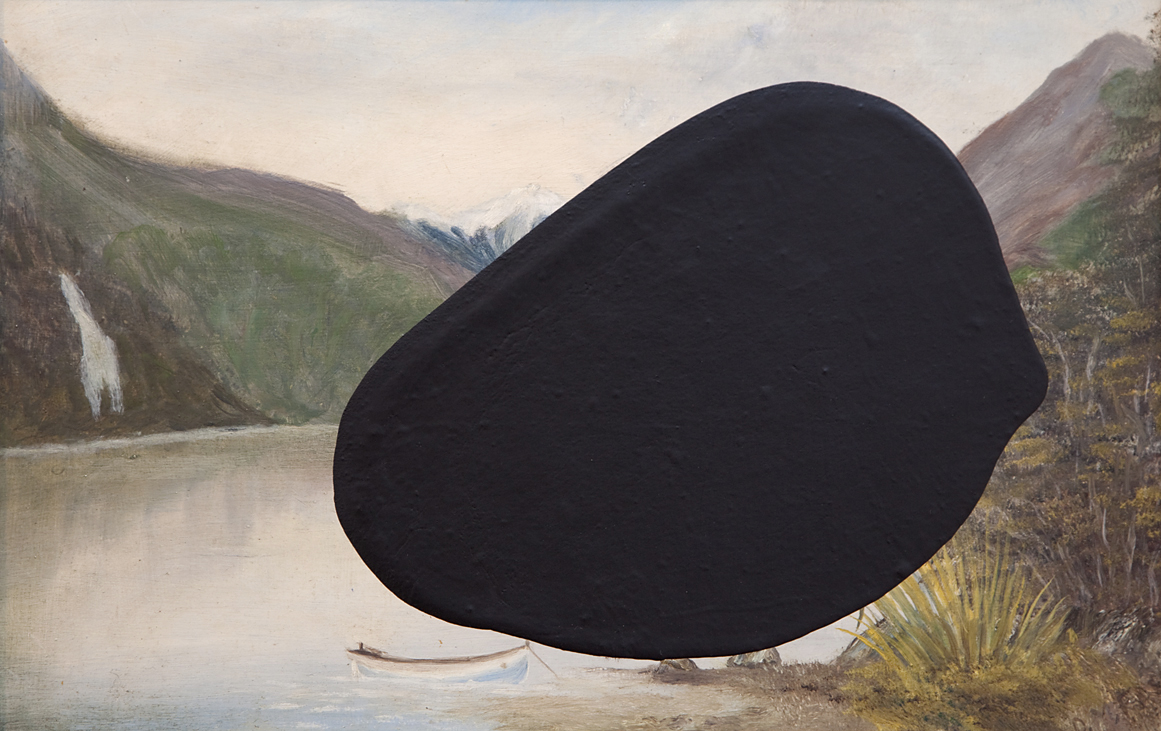
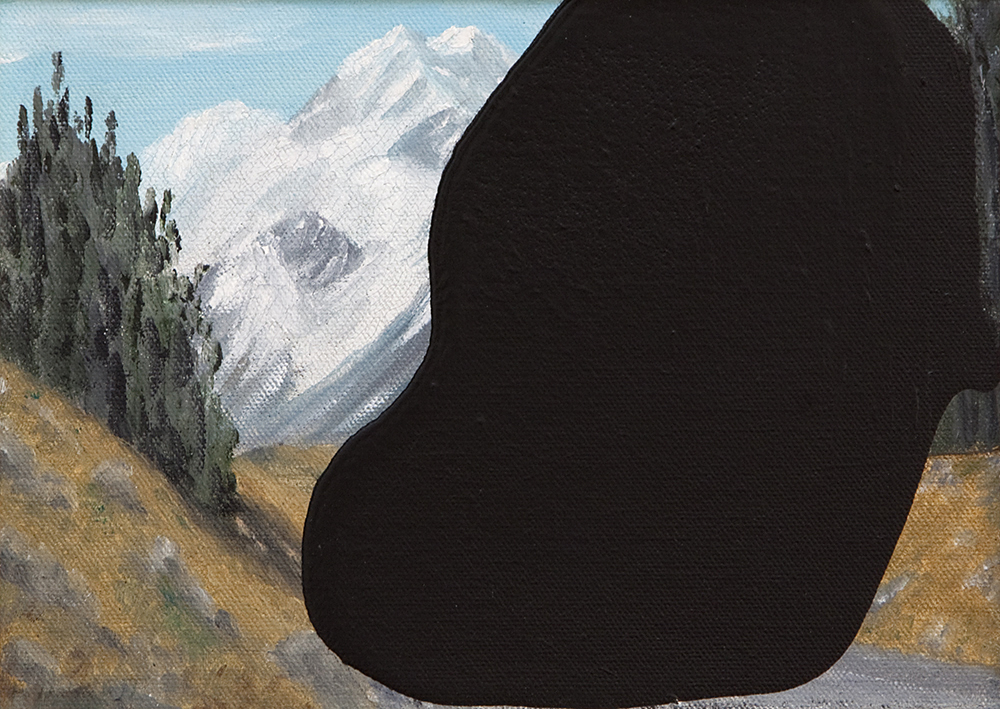
The black paint was directly poured onto certain works, like untitled (flower painting), so that it blended with the original work and created an even surface. For others, like Tukituki River and the Craggy Ranges (Hawke’s Bay), Kennedy made the black patches first by pouring house paint onto sheets of glass. The patches were then laid onto the surfaces of the found objects. Apparently, they will peel off the paintings and retain their substance, an idea I found quite appealing as I imagined the artist taking the work further, using other objects in conjunction with these thick, tactile additions. These works oddly attain a sculptural presence, as the fabricated holes, like artist Carl Andre’s, are in no sense voids. They ooze out of the original works, or they retreat into them, digging and filling simultaneously.
These plays on perspective speak to Kennedy’s artistic outlook on space. Her work references Russian Suprematism, as well as concepts of the zero gesture, anti-gravity and cosmic space. Kennedy’s work is cynical and almost nihilistic, while its self-referential and circular nature functions dialectically as painting about painting. There is something ominous in the black globs that seem to expand and float, threatening to engulf the gallery space. With regards to the subject matter of the paintings, Kennedy adopts a sardonic attitude towards rhetoric surrounding environmental sustainability and resource consumption.
In untitled (river and bush) and untitled (river and bridge), Kennedy has shaped the blue and green blobs in relation to the curvatures of the landscape in each painting. The blue of the former flows from the bank into the river; the green of the latter follows the tree line and covers all signs of the bridge. Some of the black holes in other works float in the middle, the surrounding landscape clearly visible, while others cover most of the original painting. The choice of landscape paintings could mean many things – New Zealand, a common and conventional form of amateur art, or environmental connotations.
Kennedy is also interested themes of anti-pursuit, destruction, and voids. The expression of these concepts in art is not new. Artist Sol Le Witt buried cubes underground during the sixties, acts which begged the question “Is it there if you can’t see it?” Le Witt would respond, “Does it matter as long as you’re thinking about it?” Then there were artworks which only achieved meaning once they were destroyed, either by the artist or by natural forces like gravity or erosion. They only became artworks not once their objectness was permanent, but when it was irreversibly made invisible. Artist Robert Barry once said, “Nothing seems to me the most potent thing in the world.”
The sixties also bred a strong artistic reaction to the very presence of objects, something which Kennedy feels strongly about. The idea that there are already enough objects in the world, so why make more, fueled much conceptual art. Kennedy’s work cannot be counted as conceptual art, yet its preoccupation with the readymade and non-Euclidean spatial concepts places its inspiration in that art-culture-shifting milieu. Her work seeks to nullify through adding, to disappear through painting. Figurative convention is overcome by nonobjective abstraction.
The choice of landscape is an interesting one to me. An important part of Kennedy’s process was finding that she did recognise these found objects as works of art as well. Readymades are usually explicitly non-art objects placed within an artistic context. How strongly did the subject matter determine the shape or placement of the ‘voids’? If the artist allows the found object to determine the end point, is her objective most evident in concept or process, or final product? Kennedy expressed the idea of “grey goo” consuming the world. Are these orbs that goo in artistic form? Or is the self-replicating whiteness of the gallery a consumptive space; is the white cube really a black hole?
Kennedy’s interventions (or perhaps it is all one intervention, a painting gestalt) are interesting in the proponents they conjure, from Duchamp and Malevich to Kaprow and Huebler. The work in New Voids seems more about process and concept than aesthetic, yet the substance of the voids lends them object status. Kennedy occupies the space between painting and sculpture, and her work carries forward ideas that challenge conventional notions of art process.













 a gallery presents